Business in Bangladesh 2026: Navigating the New Frontier of SMEs, Logistics, and E-Commerce
AI Summary: As Bangladesh navigates a mature economic phase in 2026, its business ecosystem is shifting from uncalibrated growth to strict efficiency. This article explores how SMEs are bypassing traditional bank credit squeezes via FinTech and moving operations to Tier-2 cities. Concurrently, the e-commerce sector has reached a multi-billion-dollar valuation by prioritizing unit economics over cash-burning, supported by automated, green logistics networks. The piece provides a comprehensive look at how these three sectors must symbiotically collaborate to drive the next decade of economic resilience.
Your Heading
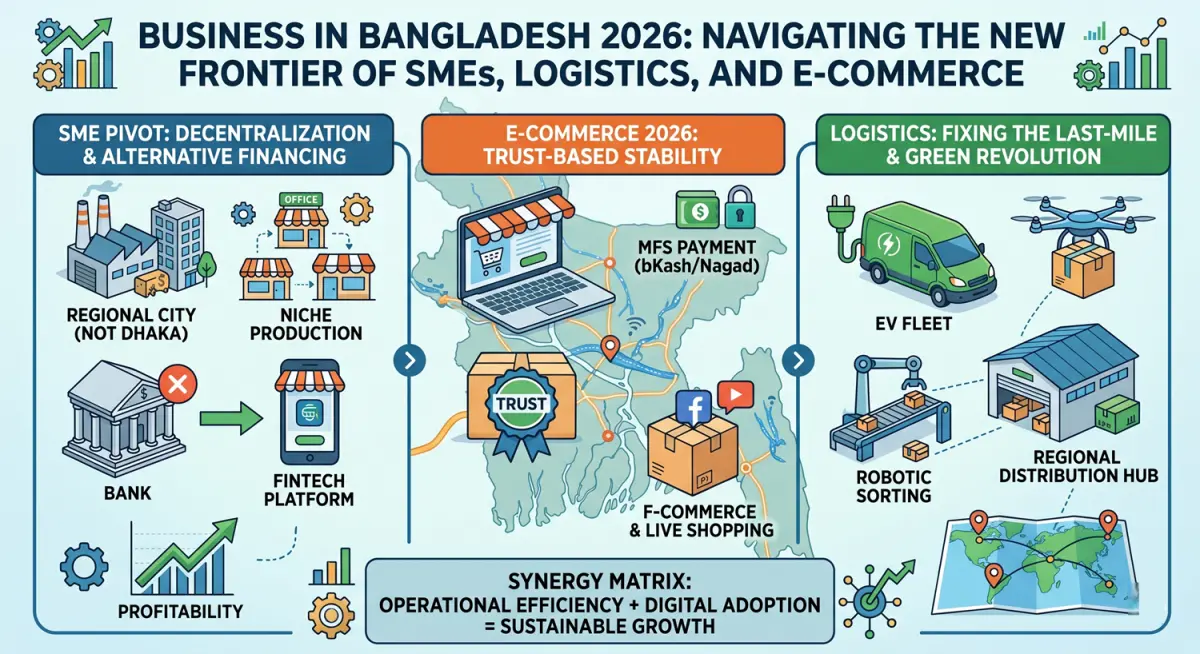
The narrative of Bangladesh’s business landscape is undergoing a massive structural shift. As we navigate 2026, the era of uncalibrated, chaotic growth has transitioned into a phase defined by regulatory maturity, fiscal tightening, and technological necessity.Faced with macroeconomic headwinds—including a projected budget deficit approaching 5% of GDP and persistent inflation hovering near 8–9%—the business ecosystem is learning to do more with less. Yet, inside this macroeconomic squeeze lies an incredible story of resilience and modernization. For Small and Medium Enterprises (SMEs), logistics tech, and digital commerce, 2026 is not about surviving the storm; it is about rewriting the playbook. 1. The SME Pivot: Moving Beyond Dhaka and Chasing EfficiencySMEs remain the backbone of the Bangladeshi economy, but their operational blueprint is drastically changing. Historically concentrated around the Dhaka-Chattogram axis, 2026 is seeing a massive decentralization wave.The Realities of 2026:The Bank Credit Squeeze: With heavy government domestic borrowing creating a crowding-out effect in the banking sector, private entrepreneurs are finding traditional bank loans harder to secure. The Rise of Alternative Financing: Forward-thinking SMEs are bypassing traditional banks, leveraging FinTech platforms, and exploring crowd-funding or specialized Mobile Financial Services (MFS) credit lines to maintain working capital.The Growth of Tier-2 and Tier-3 Cities: Urban inflation has driven operational costs through the roof in major metros. Savvy SMEs are shifting production and regional distribution to district towns like Bogura, Sylhet, and Jashore, where overhead is lower and consumer demand is surging.The 2026 Opportunity: The future belongs to "Organized Retail and Niche Production." As consumer behavior shifts toward brand trust, authenticity, and food safety, small businesses that invest in formalizing their brands and optimizing their supply chains are winning market share from the unstructured informal market.2. E-Commerce in 2026: From Hyper-Growth to Trust-Based StabilityBangladesh’s e-commerce sector is projected to cross the USD 5 to 6 billion mark in annual transaction value this year. However, the nature of this growth has fundamentally matured. The era of reckless cash-burning and predatory discounting is over; 2026 is entirely about unit economics and consumer trust. The Changing Ecosystem:Regulatory Guardrails: Thanks to the stringent implementation of escrow systems, mandatory digital invoicing, and tighter consumer protection policies by the Ministry of Commerce, consumer confidence has bounced back after years of skepticism. MFS Rules the Market: While Cash on Delivery (COD) remains a consumer favorite, Mobile Financial Services (bKash, Nagad, and Rocket) now drive over 60% of digital wallet transactions during checkout, drastically minimizing cash-handling friction for merchants. F-Commerce and Video Shopping: Social commerce (Facebook Live, TikTok, and YouTube shopping) continues to act as the primary engine for independent merchants. Consumers are demanding highly personalized, experiential shopping journeys rather than static web catalogs. 3. Logistics: Fixing the "Last-Mile" and Bridging the Regional DivideYou cannot have a multi-billion-dollar e-commerce market without a robust nervous system. In 2026, logistics is both the greatest bottleneck and the most lucrative investment frontier in Bangladesh. According to market data, the country’s freight and logistics sector has scaled to a staggering USD 32.92 billion. Yet, the industry faces a structural paradox: the country is brilliantly connected to the world, but weakly connected to itself. [Dhaka/Chattogram Centers] The Trends Transforming Logistics:Decentralized Hubs: Dhaka and Chattogram still hold roughly 70% of national warehousing capacity. The massive opportunity in 2026 lies in building decentralized regional distribution layers in under-integrated hubs like Khulna, Barishal, and Rangpur to bypass Dhaka-centric gridlocks. Warehouse Automation: Industry leaders like RedX, Pathao Courier, and Steadfast are actively rolling out automated sorting mechanisms and pilot robotics programs. Automation has already cut average fulfillment times by 15%, slashing human error in high-volume delivery centers. The Green Logistics Revolution: Sustainability is no longer a corporate buzzword—it's a cost-saving strategy. Fleet operators are aggressively transitioning to Electric Vehicles (EVs) for intra-city last-mile drops. In high-density zones like Dhaka, switching to electric delivery bikes has slashed fuel overheads by up to 20%.Source / Link: https://magazine.jar.bd/