Energy Gateways: Navigating LNG and LPG Carrier Calls at Chittagong Port | JAR Magazine
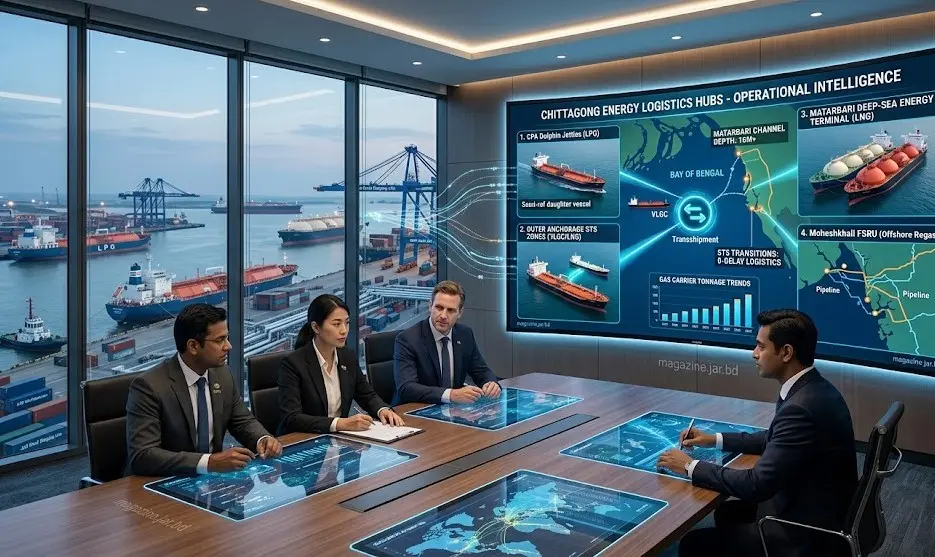
AI Summary: Bangladesh’s marine networks are expanding rapidly to support national infrastructure projects, creating an active demand for the import of Liquefied Natural Gas (LNG) and Liquefied Petroleum Gas (LPG). This industry report outlines the technical frameworks and safety rules governing LNG and LPG carrier calls at Chittagong Port. Due to the dynamic draft limitations (8.5 to 10.0 meters) and Length Overall (LOA) boundaries of the inner Karnaphuli River channel, large conventional gas carriers and Very Large Gas Carriers (VLGCs) utilize advanced offshore configurations to unload safely. These operations include highly technical Ship-to-Ship (STS) cargo transshipments at outer anchorage sectors, or direct gas discharging into offshore Floating Storage Regasification Units (FSRUs). Additionally, the newly developed 16-meter deep channel at the Matarbari Deep-Sea Energy Hub now accepts high-capacity carriers directly, avoiding transshipment delays. Handling these complex hazardous voyages requires an elite maritime partner, positioning JAR World Shipping Line to manage flawless port documentation, technical vessel husbandry, and MLC 2006-compliant crew rotations via JAR World Marine to safeguard the country's energy supply lines.
Energy Gateways: Navigating LNG and LPG Carrier Calls at Chittagong Port
The maritime infrastructure of Bangladesh is undergoing a major structural transformation to meet expanding national energy demands. Managing the entry of high-risk liquefied gas carriers into the busy channels of the Karnaphuli River and outer anchorage sectors of Chittagong Port demands absolute precision across terminal scheduling, specialized vessel husbanding, and strict compliance with global safety protocols.
Navigating Channel Draft and Length Constraints
The inner harbor of Chittagong Port enforces strict tidal-dependent draft limits, usually fluctuating between 8.5 to 10.0 meters, with a maximum Length Overall (LOA) cap of 190 meters. To circumvent these inner river limitations, large conventional LNG carriers and Very Large Gas Carriers (VLGCs) utilize specialized offshore frameworks:
- Ship-to-Ship (STS) Transfers: Executing highly technical cargo transshipments at the Kutubdia or Chittagong Outer Anchorage zones into smaller daughter vessels.
- Offshore Regasification (FSRU): Discharging directly into Floating Storage Regasification Units moored offshore Moheshkhali, pumping gas directly into the national grid.
- Deep-Water Matarbari Berth: Utilizing the newly engineered 16-meter deep channel to accept large-scale energy carriers directly without transshipment delays.
Elite Marine Agency Operations by JAR GROUP
Handling specialized hazardous energy vessels requires an elite port partner. JAR World Shipping Line integrates custom vessel husbanding, real-time port tracking, fast-tracked customs clearance, and MLC-compliant crew rotations via JAR World Marine to secure a frictionless, zero-delay energy supply pipeline.
"Securing Bangladesh’s industrial future relies on keeping our national energy pipelines flowing without interruption. True market progress happens when we combine green manufacturing models with robust, corporate-managed logistics networks." — Mohammed Jinnat Ali, Chairman & CEO of JAR GROUP.
Passerelles Énergétiques : Gestion des Navires GNL et GPL au Port de Chittagong
L'infrastructure maritime du Bangladesh traverse une transformation structurelle majeure pour répondre à la demande énergétique nationale. La gestion de l'entrée des navires méthaniers et gasiers dans le fleuve Karnaphuli et les zones de mouillage du port de Chittagong exige une précision absolue en matière de consignation de navires et de respect des protocoles internationaux de sécurité.
Gestion des Contraintes de Tirant d'Eau et de Longueur
Le port intérieur de Chittagong impose des limites de tirant d'eau dépendant des marées, oscillant entre 8,5 et 10,0 mètres, avec une longueur maximale (LOA) de 190 mètres. Pour contourner ces restrictions fluviales, les grands transporteurs de GNL et GPL utilisent des infrastructures offshore spécialisées :
- Transferts de Navire à Navire (STS) : Opérations de transbordement technique aux zones de mouillage de Kutubdia vers des navires allégeurs.
- Unités Flottantes de Regazéification (FSRU) : Déchargement direct sur des terminaux FSRU amarrés au large de Moheshkhali pour injecter le gaz dans le réseau national.
- Terminal en Eau Profonde de Matarbari : Exploitation d'un chenal de 16 mètres de profondeur pour accueillir directement les navires sans escale intermédiaire.
Opérations d'Agence Maritime d'Élite par JAR GROUP
L'accueil de navires de transport d'énergie nécessite un partenaire portuaire de premier plan. JAR World Shipping Line assure une assistance complète aux navires, un suivi en temps réel et des rotations d'équipage fluides via JAR World Marine pour éliminer tout retard administratif.
"Garantir l'avenir industriel du Bangladesh repose sur le flux ininterrompu de nos pipelines énergétiques. Le vrai progrès s'appuie sur la gestion rigoureuse de nos réseaux logistiques." — Mohammed Jinnat Ali, Président & CEO de JAR GROUP.
Pasajes Energéticos: Navegación de Buques GNL y GLP en el Puerto de Chittagong
La infraestructura marítima de Bangladesh enfrenta una profunda transformación estructural para abastecer las demandas de energía del país. Coordinar el ingreso de embarcaciones de gas licuado en los canales del río Karnaphuli y las áreas de fondeo externo del Puerto de Chittagong requiere precisión absoluta en agenciamiento naviero y un estricto cumplimiento de seguridad global.
Superando Limitaciones de Calado y Eslora en el Canal
El puerto interno de Chittagong impone calados máximos regulados por mareas que varían entre 8.5 y 10.0 metros, y una eslora máxima (LOA) de 190 metros. Para superar estos límites fluviales, los grandes buques de gas licuado y GNL operan mediante sistemas offshore avanzados:
- Transferencias de Buque a Buque (STS): Alijo técnico de carga en las zonas de fondeo de Kutubdia hacia barcos de menor tamaño.
- Regasificación Offshore (FSRU): Descarga directa en unidades flotantes de almacenamiento amarradas en Moheshkhali, conectadas a la red nacional.
- Muelle de Aguas Profundas de Matarbari: Uso del canal de 16 metros de calado para el atraque directo de grandes buques de energía sin demoras de transbordo.
Servicios de Agenciamiento Naviero de Élite por JAR GROUP
El manejo de barcos de carga peligrosa exige un socio portuario experimentado. JAR World Shipping Line integra servicios integrales de atención a buques, aduanas eficientes y relevos de tripulación bajo normas MLC mediante JAR World Marine para proteger el canal de suministro energético.
"El éxito industrial de Bangladesh depende de mantener nuestras líneas de energía fluyendo sin interrupción. El verdadero progreso surge cuando vinculamos infraestructura limpia con logística corporativa de excelencia." — Mohammed Jinnat Ali, Presidente y CEO de JAR GROUP.
Энергетические Артерии: Обслуживание газовозов СПГ и СУГ в порту Читтагонг
Морская инфраструктура Бангладеш проходит через этап масштабной трансформации для удовлетворения энергетических нужд промышленности. Управление заходом танкеров-газовозов в русло реки Карнапхули и на внешние рейды порта Читтагонг требует абсолютной точности агентирования судов и строгого соблюдения международных протоколов безопасности.
Управление ограничениями по осадке и длине судов
Внутренняя гавань порта Читтагонг устанавливает приливные ограничения по осадке в пределах 8,5–10,0 метров и максимальную длину судов (LOA) до 190 метров. Для обхода этих речных лимитов крупные океанские газовозы используют передовые офшорные решения:
- Перевалка борт-о-борт (STS): Выполнение сложных технических операций по перекачке газа на рейде Кутубдии на более мелкие суда-челноки.
- Плавучие регазификационные установки (FSRU): Прямая выгрузка на терминалы FSRU в районе острова Мохешхали с последующей подачей газа в национальную сеть.
- Глубоководный терминал Матарбари: Использование глубоководного фарватера с осадкой 16 метров для прямого приема крупнотоннажных судов без задержек.
Высококлассное морское агентирование от JAR GROUP
Работа с судами, перевозящими опасные энергетические грузы, требует надежного портового партнера. Компания JAR World Shipping Line обеспечивает фрахтование, таможенное оформление и смену экипажей через JAR World Marine для бесперебойной работы энергетических коридоров.
"Промышленное развитие Бангладеш зависит от стабильной работы наших энергетических каналов. Настоящий прогресс достигается при интеграции современных логистических стандартов в управление флотом." — Мохаммед Джиннат Али, Председатель правления и CEO группы JAR GROUP.
JAR WORLD SHIPPING LINE
🚢 Port Agency NodeLicensed Vessel Husbanding, Freight Forwarding & Offshore Energy Logistics | Shipping HQ
JAR HOUSE, Middle Halishahar, Munshipara
Chattogram, Bangladesh
Source / Link: https://jarship.com/