Logistics Reform in Bangladesh Is a Social Justice Issue
AI Summary: Bangladesh’s weak logistics are hurting exports, SMEs and disaster response. This opinion argues that logistics reform is not just economic policy—it is a social justice imperative.
Opinion: Logistics Reform in Bangladesh Is a Social Justice Issue
In recent weeks, economists and business leaders have repeated one striking statistic: if Bangladesh could cut logistics costs by 25%, exports might rise by around 20%, and even a 1% reduction in freight costs could lift exports by about 7.4%. These numbers show why policymakers talk so much about ports, roads and customs. But logistics reform is not only an export or GDP issue—it is also a social justice issue that affects workers, small businesses and disaster-hit communities across the country.
The reality is simple: when logistics are weak, it is the most vulnerable who pay the highest price. Farmers, SMEs, low-income workers and local NGOs all struggle with higher costs, long delays and broken supply chains, while big players are often better able to absorb shocks.
Export dreams depend on logistics reality
Bangladesh now talks about reaching 100 billion dollars in export earnings and “moving up global value chains”. Yet recent analyses show that our logistics ecosystem is deteriorating compared to competitors, with congested ports, slow customs and high transport costs putting pressure on exporters.
Think tanks and business chambers warn that overdependence on ready-made garments—still more than 80% of total exports—combined with weak logistics is a serious risk as Bangladesh moves toward LDC graduation. Without faster and cheaper logistics, diversification into value-added textiles, agro-processing, light engineering and branded consumer goods will remain more slogan than reality.
When trucks are stuck, people are stuck
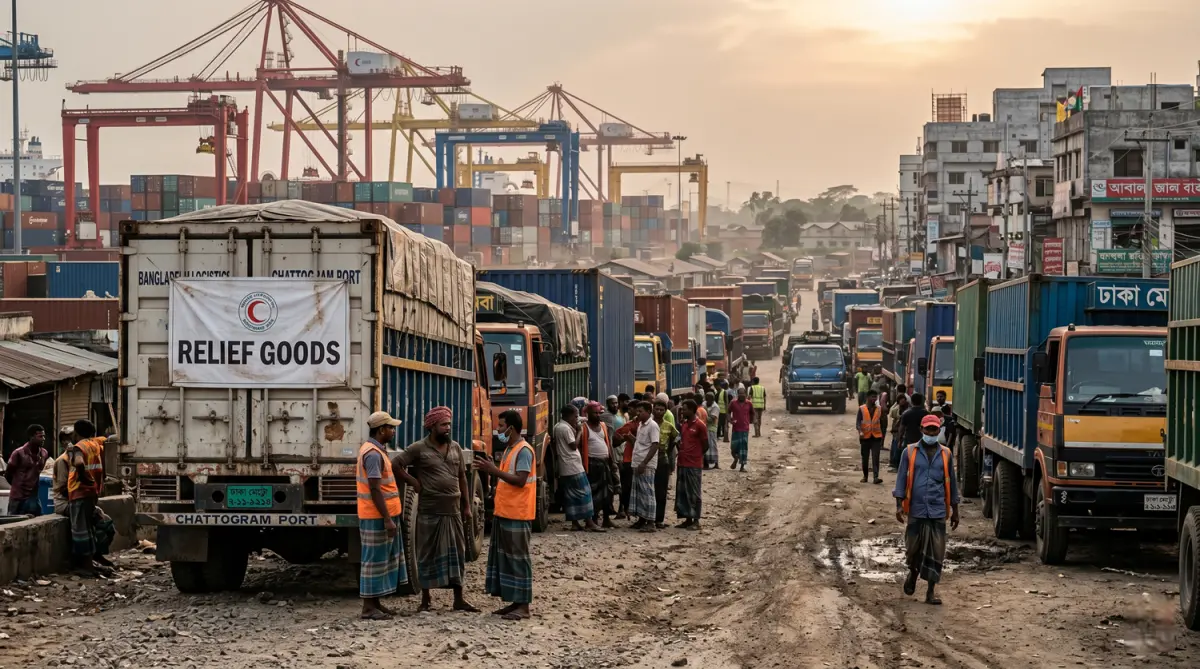
Behind every delayed container is a chain of people whose lives are affected. A shipment stuck at Chattogram port can mean factory overtime, cancelled orders, withheld payments and lost bonuses for workers. For SMEs, which usually have less bargaining power and thinner margins, a week-long delay can be the difference between survival and closure.
Humanitarian organisations have also described how poor logistics slow down disaster response. During floods and cyclones, small NGOs are often the first to reach affected communities, but they struggle with damaged roads, lack of storage, limited transport options and weak coordination. Investing in better logistics—transport, warehousing, digital tools—would not only help exporters; it would literally save lives in emergencies and reduce suffering for people who are already at risk.
A reform agenda with people at the centre
Experts have already drawn up detailed roadmaps. They call for implementing the National Logistics Policy, modernising ports, cutting container dwell time at Chattogram, fully operationalising a National Single Window for customs, integrating road-rail-waterway networks and using digital tracking and even AI in cargo flows.
These reforms will certainly help business competitiveness. But to make them truly transformative, we need to ask:
- How will they lower costs and improve reliability for small producers and SMEs, not only for big exporters?
- How will they support faster, more equitable disaster response for flood-prone districts?
- How can public-private partnerships in ports and logistics be designed to protect workers’ rights, fair tariffs and community interests, not just investor returns?
In other words, logistics policy should be judged not only by how much it increases export volumes, but also by how it changes everyday life for ordinary citizens.
The role of logistics companies and SMEs
Logistics firms, freight forwarders and shipping lines are not just service providers; they are part of the solution. By investing in digital tracking, transparent pricing, training and reliable customer communication, companies like JAR WORLD LOGISTICS, JAR WORLD SHIPPING LINE and others can reduce uncertainty for exporters and importers, especially SMEs.
SMEs, in turn, can push for better service by choosing partners who offer visibility, honest transit-time estimates and clear escalation channels. When small businesses and logistics providers speak together—at chambers, roundtables and policy forums—their combined voice can push logistics reform higher up the national agenda.
A call to re-frame the debate
Bangladesh cannot become a truly competitive, resilient and fair economy if goods, relief supplies and essential services are stuck in traffic, paperwork and port queues. Logistics reform is one of the highest-impact starting points for a new government that wants quick, visible improvements in both business confidence and human well-being.
We should therefore re-frame logistics from a technical topic to a human one. Every hour a container waits, someone loses income. Every day a relief truck is delayed, a family waits longer for clean water and medicine. Making logistics faster, cheaper and more reliable is not just about hitting export targets—it is about giving people, especially the most vulnerable, a fairer chance in the Bangladeshi economy.
Contact JAR WORLD LOGISTICS
JAR WORLD LOGISTICS
Professional Freight Forwarding, Shipping & Project Logistics Services
Email:
[email protected]
Website:
www.jarship.com
WhatsApp / WeChat:
+8801730004456
Office:
JAR HOUSE, Middle Halishahar,
Chattogram, Bangladesh
JAR Group Global Services
Integrated maritime, logistics, recruitment, trading, and consumer brands from the JAR Group ecosystem.
🚢 JAR WORLD SHIPPING LINE
Port agency, vessel operations, cargo coordination, and maritime support services.
Visit Website📦 JAR WORLD LOGISTICS
Freight forwarding and international logistics coordination for global trade.
Learn More🌍 JAR LIMITED
International trading company developing consumer brands and business partnerships.
Visit Website🛒 JARSHOPS.COM
Online marketplace for JAR products including tea, groceries, and lifestyle goods.
Shop Now🌿 NISSUL ASIA
Premium tea, honey, spices, and natural products developed under the NISSUL brand.
Visit WebsiteSource / Link: https://jarship.com/