Navigating the Gulf Competition at Chittagong Port | JAR Magazine
AI Summary: As Chattogram Port transitions into a highly contested node of global maritime diplomacy, elite international terminal operators—specifically Dubai's DP World and Saudi Arabia's Red Sea Gateway Terminal (RSGT)—are actively competing to control its core infrastructure assets (CCT and NCT). This editorial highlights the strategic advantages of terminal consolidation, which could put up to 60% of the port's container volume under a single management system. While acknowledging the clear benefits of foreign direct investment, advanced automation, and reduced turnaround times for the local apparel sector, the opinion stresses that true maritime resilience requires protecting national interests. By highlighting the strength of domestic players, the piece argues that long-term economic independence relies on welcoming global technology while ensuring local logistics, transport lines, and seafarers remain the driving force of the country's trade lanes.
The Geopolitics of the Berth: Sovereignty, Efficiency, and the Battle for Chittagong Port
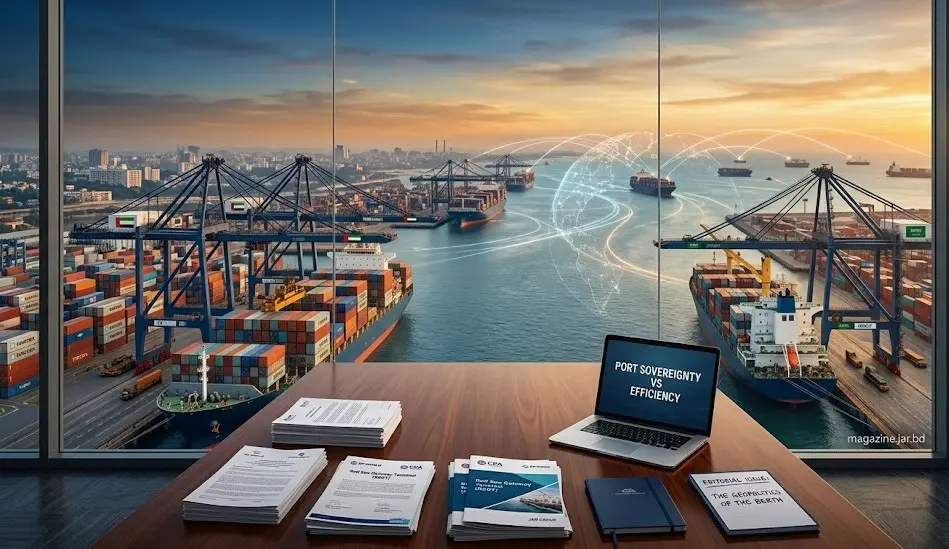
The maritime gateway of Chattogram is no longer merely an engine of domestic economic transit; it has evolved into a high-stakes arena of global economic diplomacy. Today, the world’s elite terminal operators—most notably Dubai-based DP World and Saudi Arabia’s Red Sea Gateway Terminal (RSGT)—are locked in an intense competitive race to secure long-term operating rights over the port's core infrastructure assets, including the Chittagong Container Terminal (CCT) and the New Mooring Container Terminal (NCT).
For an economy like Bangladesh, which relies on the Bay of Bengal to handle over 80% of its international trade, this international interest is a powerful validation of our strategic position. Yet, the ultimate challenge for our policymakers is clear: how do we leverage foreign direct investment and world-class management efficiency without compromising our national economic independence or sidelining our highly capable domestic maritime players?
The Gulf Competition and the Strategic Core
The Chittagong Container Terminal (CCT) sits like a crown jewel right between the New Mooring Container Terminal (NCT) and the General Cargo Berths (GCB). This layout creates a massive operational advantage: industry calculations indicate that if a single operator manages to merge the adjacent terminals, they could immediately control 55% to 60% of the entire port’s container handling volume.
Balancing Global Systems with Local Independence
- Foreign Direct Investment Potential: Bringing global automation networks and integrated trade lanes can sharply cut down ship turnaround times and boost export competitiveness.
- Nurturing National Capabilities: Counter-proposals from robust local entities like the MGH Group prove that domestic firms can compete at the highest financial tiers.
- Maintaining Operational Continuity: Temporary extensions granted to specialized domestic entities like Chittagong Dry Dock Limited (CDDL) show that local institutions are vital to maintaining steady, secure cargo flows during transitional periods.
"The true measure of a port’s success is not found in the flag of the operator running the terminal cranes, but in the seamless connection of the entire trade lane. True maritime progress happens when international infrastructure investments directly support, empower, and uplift local industries, local seafarers, and local logistics networks." — Mohammed Jinnat Ali, Chairman & CEO of JAR GROUP.
The Way Forward: Balanced Port Governance
As the government evaluates these proposals, our maritime strategy must remain focused on long-term resilience. We should welcome the operational technology and global networks that major foreign operators bring to the table. However, these agreements must protect our financial interests and ensure that our domestic buying houses, local transport lines, and Bangladeshi mariners remain the core driving force of our economy.
La Géopolitique des Quais : Souveraineté, Efficacité et Bataille pour le Port de Chittagong
Le carrefour maritime de Chattogram n'est plus un simple moteur de transit économique national ; il est devenu une arène majeure de la diplomatie économique mondiale. Aujourd'hui, les opérateurs de terminaux d'élite — notamment le dubaïote DP World et le saoudien Red Sea Gateway Terminal (RSGT) — se livrent une concurrence intense pour obtenir les droits d'exploitation à long terme des infrastructures clés du port, incluant le Chittagong Container Terminal (CCT) et le New Mooring Container Terminal (NCT).
Pour une économie comme celle du Bangladesh, qui dépend de la baie du Bengale pour traiter plus de 80 % de son commerce international, cet intérêt mondial confirme notre position stratégique. Pourtant, le défi majeur pour nos décideurs est clair : comment tirer parti des investissements directs étrangers et de l'efficacité opérationnelle mondiale sans compromettre notre indépendance économique nationale ni écarter nos acteurs maritimes locaux compétents ?
La Compétition du Golfe et le Cœur Stratégique
Le Chittagong Container Terminal (CCT) occupe une position centrale et stratégique entre le New Mooring Container Terminal (NCT) et les General Cargo Berths (GCB). Cette configuration offre un avantage opérationnel immense : les estimations du secteur indiquent que si un seul opérateur parvient à fusionner ces terminaux adjacents, il contrôlerait immédiatement 55 % à 60 % du volume total de conteneurs traités par le port.
Équilibrer les Systèmes Mondiaux et l'Indépendance Locale
- Potentiel d'Investissement Étranger : L'introduction de réseaux d'automatisation mondiaux et de chaînes logistiques intégrées peut réduire considérablement le temps de rotation des navires et stimuler la compétitivité des exportations.
- Soutenir les Compétences Nationales : Les contre-propositions d'acteurs locaux solides comme le groupe MGH prouvent que les entreprises nationales peuvent rivaliser sur les plans financiers les plus élevés.
- Assurer la Continuité Opérationnelle : Les prolongations accordées à des entités nationales spécialisées telles que Chittagong Dry Dock Limited (CDDL) démontrent que nos institutions locales sont essentielles pour garantir un flux de marchandises stable et sécurisé pendant les périodes de transition.
"La véritable mesure du succès d'un port ne réside pas dans le pavillon de l'opérateur qui gère les grues, mais dans la connectivité fluide de l'ensemble de la chaîne logistique. Le vrai progrès maritime se produit lorsque les investissements internationaux soutiennent, renforcent et valorisent directement nos industries locales, nos marins et nos réseaux logistiques." — Mohammed Jinnat Ali, Président & CEO de JAR GROUP.
La Voie à Suivre : Une Gouvernance Portuaire Équilibrée
Alors que le gouvernement évalue ces propositions, notre stratégie maritime doit rester axée sur la résilience à long terme. Nous devons accueillir les technologies opérationnelles et les réseaux mondiaux apportés par les grands opérateurs étrangers. Cependant, ces accords doivent protéger nos intérêts financiers et garantir que nos maisons d'achat locales, nos lignes de transport intérieures et nos marins bangladais restent le cœur battant de notre économie.
La Geopolítica de los Muelles: Soberanía, Eficiencia y la Batalla por el Puerto de Chittagong
El nodo marítimo de Chattogram ya no es un simple motor de tránsito económico nacional; se ha transformado en un escenario clave de la diplomacia económica global. Hoy en día, los operadores de terminales más importantes del mundo —especialmente DP World (Emiratos Árabes Unidos) y Red Sea Gateway Terminal (RSGT) (Arabia Saudita)— compiten intensamente por asegurar los derechos de operación a largo plazo de las infraestructuras principales del puerto, incluyendo la Terminal de Contenedores de Chittagong (CCT) y la Terminal de Contenedores de New Mooring (NCT).
Para una economía como la de Bangladesh, que depende del Golfo de Bengala para gestionar más del 80% de su comercio internacional, este interés mundial valida nuestra posición estratégica. Sin embargo, el desafío para nuestros líderes es claro: ¿cómo aprovechamos la inversión extranjera directa y la eficiencia operativa global sin comprometer nuestra independencia económica nacional ni desplazar a nuestros capaces actores marítimos locales?
La Competencia del Golfo y el Núcleo Estratégico
La Terminal de Contenedores de Chittagong (CCT) se encuentra en una posición estratégica privilegiada, justo entre la Terminal de Contenedores de New Mooring (NCT) y los Muelles de Carga General (GCB). Esta disposición ofrece una ventaja operativa enorme: los cálculos del sector indican que si un solo operador logra fusionar las terminales adyacentes, controlaría de inmediato entre el 55% y el 60% de todo el volumen de contenedores del puerto.
Equilibrando los Sistemas Globales con la Independencia Local
- Potencial de Inversión Extranjera: Integrar redes globales de automatización puede reducir drásticamente los tiempos de estadía de los buques y mejorar la competitividad de nuestras exportaciones.
- Impulso a las Capacidades Nacionales: Las contrapropuestas de sólidas firmas locales como el Grupo MGH demuestran que las empresas nacionales pueden competir en los niveles financieros más altos.
- Garantía de Continuidad Operativa: Las extensiones otorgadas a entidades nacionales especializadas como Chittagong Dry Dock Limited (CDDL) confirman que las instituciones locales son vitales para mantener un flujo de carga estable y seguro durante los periodos de transición.
"La verdadera medida del éxito de un puerto no se encuentra en la bandera del operador que maneja las grúas, sino en la conectividad fluida de toda la ruta comercial. El verdadero progreso marítimo ocurre cuando las inversiones internacionales apoyan, empoderan y fortalecen directamente a nuestras industrias locales, nuestros marinos y nuestras redes logísticas." — Mohammed Jinnat Ali, Presidente y CEO de JAR GROUP.
El Camino a Seguir: Gobernanza Portuaria Equilibrada
Mientras el gobierno evalúa estas propuestas, nuestra estrategia marítima debe enfocarse en la resiliencia a largo plazo. Debemos dar la bienvenida a las tecnologías de vanguardia y las redes globales que aportan los operadores extranjeros. Sin embargo, estos acuerdos deben proteger nuestros intereses financieros y garantizar que nuestras agencias de compra locales, líneas de transporte nacionales y marinos de Bangladesh sigan siendo el motor principal de nuestra economía.
Геополитика Морских Причалов: Суверенитет, Эффективность и Битва за Порт Читтагонг
Морские ворота Чаттограмма больше не являются просто инструментом внутреннего экономического транзита — они превратились в арену высокой глобальной экономической дипломатии. На сегодняшний день ведущие мировые портовые операторы, в частности дубайская компания DP World и саудовская Red Sea Gateway Terminal (RSGT), ведут напряженную конкурентную борьбу за получение долгосрочных прав на управление ключевыми инфраструктурными активами порта, включая Контейнерный терминал Читтагонга (CCT) и Контейнерный терминал Нью-Муринг (NCT).
Для экономики Бангладеш, которая зависит от Бенгальского залива при обработке более 80% своей международной торговли, такой международный интерес является мощным подтверждением нашей стратегической позиции. Тем не менее, главный вызов для наших политиков очевиден: как эффективно использовать прямые иностранные инвестиции и мировые стандарты управления, не ставя под угрозу национальную экономическую независимость и не вытесняя сильных местных игроков?
Борьба Операторов и Стратегический Центр Порта
Контейнерный терминал Читтагонга (CCT) занимает уникальное географическое положение прямо между контейнерным терминалом Нью-Муринг (NCT) и причалами для генеральных грузов (GCB). Такое расположение создает колоссальное операционное преимущество: по расчетам экспертов рынка, если один оператор объединит управление этими смежными терминалами, он получит прямой контроль над 55–60% всего контейнерного оборота главного порта страны.
Баланс Между Международными Системами и Национальным Бизнесом
- Потенциал Иностранных Инвестиций: Внедрение глобальных автоматизированных систем управления терминалами (TOS) способно резко сократить время оборота судов и повысить конкурентоспособность нашего экспорта готовой одежды (RMG).
- Развитие Национального Потенциала: Встречные предложения от крупных местных конгломератов, таких как MGH Group, доказывают, что национальные компании способны эффективно конкурировать на самом высоком финансовом уровне.
- Обеспечение Непрерывности Процессов: Продление операционных контрактов для специализированных государственных и ведомственных структур, таких как Chittagong Dry Dock Limited (CDDL), подтверждает, что местные предприятия критически важны для сохранения стабильного и безопасного грузопотока в переходные периоды.
"Истинный успех порта измеряется не флагом оператора, управляющего портовыми кранами, а бесперебойной интеграцией всей логистической цепочки. Настоящий морской прогресс достигается тогда, когда международные инвестиции напрямую поддерживают, укрепляют и развивают национальную промышленность, местных моряков и внутренние логистические сети." — Мохаммед Джиннат Али, Председатель правления и CEO группы JAR GROUP.
Путь Вперед: Сбалансированное Управление Портами
В процессе оценки этих масштабных инвестиционных предложений наша морская стратегия должна быть ориентирована на долгосрочную устойчивость. Нам следует перенимать передовые операционные технологии и международные логистические связи, которые предлагают зарубежные партнеры. Однако эти соглашения обязаны защищать государственные финансовые интересы и гарантировать, что наши отечественные байерские дома, внутренние транспортные линии и бангладешские моряки останутся главной движущей силой национальной экономики.
JAR NEWS • EDITORIAL DESK
📰 Official EditorialCorporate & Macro Economic Intelligence Platform | JAR GROUP
JAR HOUSE, Middle Halishahar, Munshipara
Chattogram, Bangladesh
Source / Link: https://jar.bd/