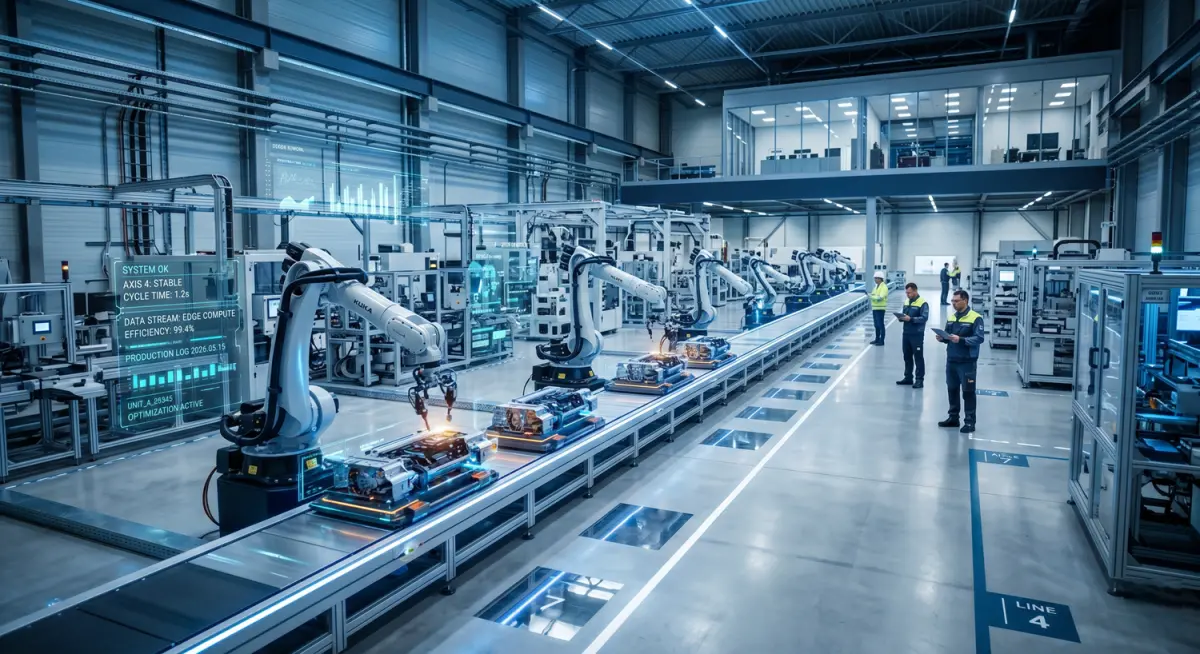
The Next Shift: Three Industrial Automation Frontiers Defining 2026
AI Summary: Discover how real-time edge computing, autonomous supply chains, and AI-driven maintenance are defining industrial operations this year. Read the executive guide for JAR Business & Industry Magazine.
The Next Shift: Three Industrial Automation Frontiers Defining 2026
The global industrial sector is no longer merely reacting to the disruptions of the early 2020s. Today, operational resilience isn't a goal—it is the baseline. As we cross the mid-point of 2026, the intersection of heavy industry and intelligent technology has moved past experimental pilots. Forward-thinking enterprises are deploying deeply integrated systems that decentralize decision-making right on the factory floor.
For executive leadership, navigating this landscape requires looking beyond generic digital transformation buzzwords. Success this year hinges on three core automation frontiers that are actively shifting production metrics from reactive management to autonomous optimization.
1. The Migration to the Edge
While cloud computing revolutionized data storage and high-level analytics, the modern manufacturing floor demands split-second latency that centralized servers simply cannot provide. In 2026, the focus has firmly shifted to advanced edge computing.
By processing data directly on the shop floor—closer to the sensors, robotics, and programmable logic controllers (PLCs)—facilities are minimizing latency to near-zero. This decentralization allows for immediate automated adjustments to assembly line anomalies, drastically cutting down on defective outputs and protecting machinery before a fault cascades into system-wide downtime.
2. From Predictive to Prescriptive AI Maintenance
Predictive maintenance used to be the gold standard: a system flagged a vibrating bearing, and a technician scheduled a fix. Today, industrial leaders are implementing prescriptive maintenance systems.
Powered by localized AI models, these networks do not just predict an upcoming hardware failure; they dynamically rewrite their own operational parameters to avoid it. If a CNC machine shows signs of thermal stress, the system automatically recalibrates feed speeds and coordinates with inventory software to order replacement parts—all while scheduling an automated maintenance window during low-demand hours.
3. Autonomic Supply Chain Synchronization
The modern assembly line is only as fast as its weakest supplier link. The traditional barrier separating the factory floor from external logistics has dissolved.
Through secure, cross-enterprise data fabrics, factory automation systems now talk directly to vendor logistical pipelines. When regional shipping delays or material shortages are detected upstream, the smart factory autonomously alters its production scheduling, reallocating robotic workflows to alternative product lines without requiring human intervention.
About JAR GROUP
JAR GROUP
Shipping, Logistics, Marine, Trade, E-Commerce and Digital Business Platform from Bangladesh
Email:
[email protected]
Website:
www.jarinfo.com
www.jarship.com
WhatsApp / WeChat:
+8801730004456